Emery Staines
The LuminariesEmery Staines is a young prospector whose sudden disappearance unsettles Hokitika and whose eventual return exposes the liabilities hidden beneath his reputation for extraordinary good fortune. Rich in claims but entangled in disputed gold, a concealed deed, and a prolonged absence caused by opium use, he is at once a missing man, a benefactor to Anna Wetherell, and a mine owner who has withheld earnings owed to others.
Identity and Early Standing
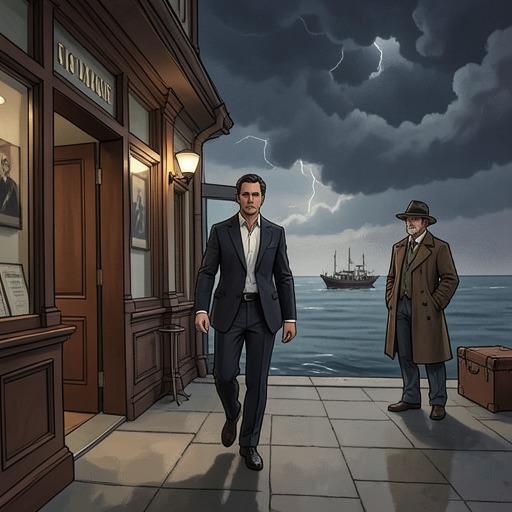
Staines is introduced as a notably successful young man on the West Coast. He owns more than a dozen claims, some with shafts at least thirty feet deep, and is regarded as the richest man south of the black sands. Thomas Balfour admires him and imagines him as a man in his early twenties, with a good-natured, hopeful appearance and an affable, optimistic, quick temperament. The thought that Staines might be dead, and especially that he might have been murdered, is painful to Balfour precisely because it clashes with this impression of open, fortunate youth.
Staines’s actual age is made clearer when he is eventually brought back to Hokitika: he is about twenty-one, perhaps younger. Cowell Devlin is startled by the contrast between this very young man and the wealthy mine owner whose disappearance has become a public matter. The difference between Staines’s apparent command of the goldfield and his youth is central to his character: he has acquired substantial property and authority before he has shown himself capable of bearing the obligations that accompany them.
His public absence is first registered through ordinary traces. Walter Moody finds a missing-prospector notice in the West Coast Times asking whether Staines, or anyone who knows his whereabouts, might see it. The surrounding paper is full of local advertisements and reports, making the notice part of Hokitika’s everyday life rather than an isolated mystery. Staines’s name becomes one item among many in a town where fortune and disappearance are familiar possibilities.
Disappearance and Uncertain Fate
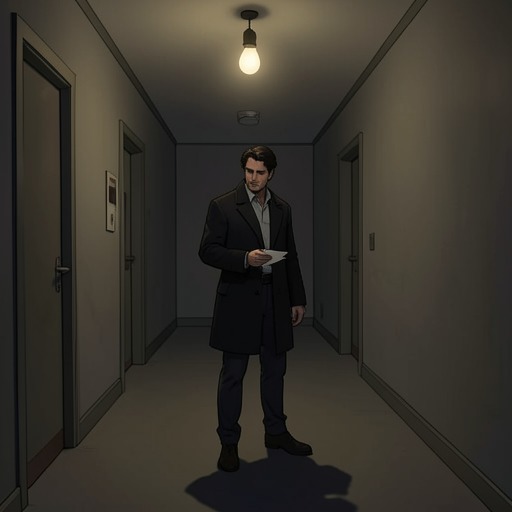
The information available to the authorities places Staines last on the evening of 14 January 1866, walking south along Revell Street toward his home. The next morning, his barber finds the door unlocked. The bed appears recently slept in and the fire has gone cold, but valuables remain untouched. These details offer no clear sign of flight for profit or of a robbery, and the absence of an explanation makes the vanished prospector difficult to classify as either fugitive or victim.
As weeks pass, speculation turns toward death without resolving it. Moody encounters a man apparently trapped in a shipping case aboard the Godspeed, calling repeatedly for Magdalena; the episode briefly gives the missing-man inquiry a possible connection to the ship’s cargo. But the delivered news that no corpse was found among the cargo does not establish where Staines is. Moody recognizes the uncertainty: if Staines drowned, whether by accident or design, the absence of a body could leave the circumstances unknowable. The case has no confirmed body and, at that stage, no identified killer.
That uncertainty has material consequences. After Staines has been absent for more than eight weeks, the Magistrate rules that the period is sufficient to extinguish ownership of his gold-bearing ground. His claims, including the Aurora, are returned to the Crown. John Long Quee is thereby released from his obligation to work the barren claim and travels to Hokitika to ask where, and for whom, he must work next. Staines’s disappearance is not merely a personal mystery: it changes the legal status of land and the working conditions of a laborer bound to his claim.
Anna Wetherell, Crosbie Wells, and the Deed
Staines’s connection to Anna Wetherell is documented before his disappearance. On 11 October 1865, a deed records a gift of £2,000 from Staines, formerly of New South Wales, to Wetherell, also formerly of New South Wales, with Crosbie Wells presiding as witness. The document bears Staines’s name but not his signature. It therefore points toward a substantial intended gift without, on its own, settling whether the transfer was completed or what legal force the paper possesses.
The amount links the private promise to the larger fortune at the center of the inquiry. When the deed is later considered alongside gold found in Wells’s cottage, George Shepard interprets it as evidence that the money originated with Staines and that he intended to give Wetherell half. This is an inference drawn from the document, not a complete account of how the gold reached the cottage. The deed does, however, make Wells more than a chance witness: it suggests an association between him and Staines, and a role in holding or safeguarding wealth connected to Wetherell.
Wetherell’s own account adds a personal dimension without resolving the matter. When asked about the relevant man, she says she had been with someone named Staines. Her statement connects them directly, while the deed supplies a specific financial promise. In the later investigation, Staines’s disappearance on the same day as Wells’s death sharpens the questions surrounding their relationship, the fortune, and the reason the money was concealed. The evidence establishes the connection and the promise more firmly than it explains their private understanding.
The Aurora Fortune and Unpaid Obligations
Staines’s wealth is bound to the Aurora, where his position is more complicated than his public prosperity suggests. Frank Carver owns half the mine, making the two men partners in practical terms. The claim initially performs well, bringing in nearly £100 during its first month after purchase, but its recorded returns fall sharply by August. Over the following quarter, the books show only £12 in profits, despite the apparent promise of the mine. The contrast between the mine’s reputation and its accounts prompts Charlie Frost’s scrutiny and helps reveal how much of Staines’s success rests on concealed records.
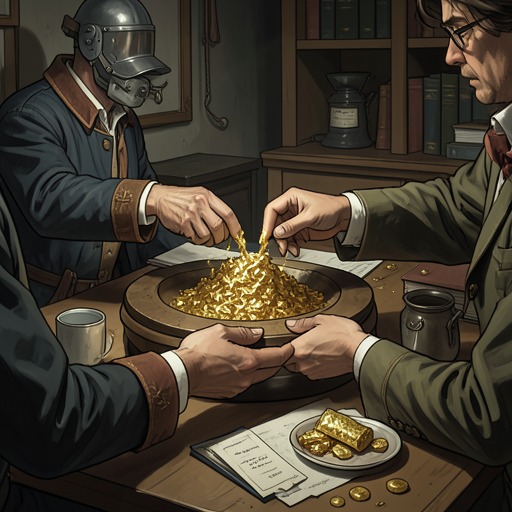
The gold in dispute has a specific chain of work and custody. John Long Quee, Staines’s employee, excavates the ore, retorts it into squares, and submits it as legal earnings. Staines later acknowledges that the gold came from the Aurora and that Quee had produced it. Instead of banking the returns against the claim as required, Staines bags the gold and takes it to the Arahura Valley, where he buries it. In court, he admits that the concealed gold is worth £4,096. The fortune is therefore not simply private wealth: it represents mine production that should have appeared in the accounts and earnings attributable to Quee’s labor.
The accounting also implicates Staines in obligations to Carver. At trial he pleads guilty to falsifying the Aurora records to avoid payments calculated at fifty percent of net profit owing to his partner. He also admits to avoiding a bonus owed to John Long Quee, although its value is not specified. The apparent collapse of the mine’s returns and the hidden gold thus resolve into more than a puzzling bookkeeping anomaly. Staines has concealed a bonanza while leaving the official record to suggest that the claim barely covers its costs.
The gold’s association with Anna Wetherell and Wells further complicates ownership. A fortune discovered at Wells’s house is linked by the unsigned deed to a promised gift from Staines, while the investigation also traces gold sewn into Wetherell’s dresses and converted into Aurora-stamped squares. Four of her five gowns have been stripped of gold by Quee Long; Wetherell later discovers gold remaining in the fifth, her orange dress, and hides it with Aubert Gascoigne. These separate locations and transfers prevent the fortune from being reduced to a single cache under Staines’s control. His own admission confirms that he concealed gold from the Aurora, but the full distribution of the wealth has involved other people and other acts of concealment.
Recovery, Admission, and Narrative Role
Staines is found alive at Wells Cottage after his disappearance. Te Rau Tauwhare discovers him there, badly weakened by a gunshot injury, and brings him back to Hokitika with Joseph Pritchard. When he arrives at the gaol-house, Devlin is struck by the disparity between the wealthy, missing mine owner he had imagined and the pale, sunken-eyed young man in Tauwhare’s care. His recovery ends the uncertainty over whether he has drowned, but it does not immediately explain the disappearance or clear him of suspicion.
At the April proceedings, Staines pleads guilty to falsifying the Aurora accounts, embezzling the gold excavated by John Long Quee, and burying it in the Arahura Valley to conceal it. He also admits that excessive and prolonged opium consumption has incapacitated him for the preceding two months. The admission connects the missing-person interval with his failure to perform his duties, while confirming that the concealed fortune was deliberate. The evidence supports this explanation of his absence and dereliction; it does not turn his prior concealment into an innocent act.
The novel’s treatment of Staines depends on a reversal between reputation and record. First, his wealth and cheerful character make murder seem more plausible than self-interest; then the missing mine returns, unsigned deed, and hidden bars make him an object of suspicion; finally, his own plea establishes both his carelessness and his fraud. At the same time, his dealings with Wells and Wetherell suggest loyalty and generosity alongside concealment. He is not defined by a single explanation for fortune: he can promise a large gift, trust Wells, and still deprive Carver and Quee of earnings owed to them.
Staines’s story therefore tests what it means to call a man fortunate. His claims and wealth rest on labor, partnership, and records that he can falsify, while the people affected by his choices occupy unequal positions within those arrangements. His disappearance suspends the question of whether wealth has made him a victim; his return reveals that he has also made others bear the cost of his secrecy. The man who reappears is no longer only the promising prospector in the newspaper notice, but a young owner whose fortune carries debts that a buried hoard cannot erase.